If you have ever tweezed a white hair on your scalp, you probably noticed one thing right away. It takes longer to come back than the hair you shave, and sometimes it feels like the area looks a bit thinner for a while. That can make you wonder if tweezing actually reduces hair growth on the head, or if it is slowly damaging the follicle.
Hair removal is a huge part of personal care. Healthline notes that, according to Statista and data from the U.S. Census and Simmons National Consumer Survey, 28.05 million Americans used hair removal products at home in 2019. If you want a clear, simple answer on what tweezing really does to scalp hair, keep reading and we will break it down step by step.
What Is Tweezing and How Does It Remove Hair?
Tweezing is a form of plucking. A tweezer grips the hair shaft and pulls it out from the root, meaning the hair is removed from inside the follicle, not just cut at the surface. With tweezing, the follicle has to build a brand new hair fiber before you see it again, so the “smooth time” feels longer.
Understanding Hair Regrowth After Tweezing
To understand regrowth, it helps to know how hair normally behaves. Scalp hair follows a cycle with a growth phase, a transition phase, and a resting phase, which explains why hair fall can be part of the normal growth cycle. Most scalp hairs spend a long time in the growth phase, which is one reason head hair can grow long.
When you pluck a hair, you remove the visible strand and the root portion, but the follicle itself usually stays alive. In most cases, the follicle simply starts the process again and produces another hair. That is why, for most people, tweezing does not “turn off” hair growth on the scalp, it just resets that single hair’s timeline.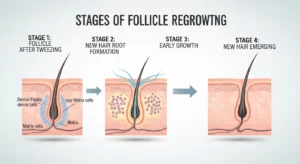
Does Tweezing Affect Hair Thickness or Growth Speed?
Most of the time, tweezing does not permanently change how thick your hair grows or how fast it grows, similar to what people explore when asking whether combing helps hair growth. A new hair can look different for a few normal reasons, such as:
The hair was plucked during a different point in its cycle, so the return feels delayed. You are comparing it to neighboring hairs that are in a strong growth phase. The hair breaks during tweezing, so it grows back looking finer at first, then thickens as it matures.
There is also a common illusion: when you repeatedly tweeze the same small spot, you are constantly removing the strongest visible hairs in that zone. So the area can look less dense, even though the follicles are still capable of producing hair.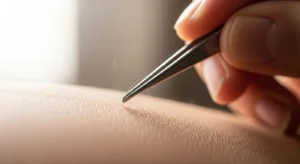
Can Frequent Tweezing Damage Hair Follicles?
This is where the answer becomes more cautious. Occasional tweezing of a random stray hair is usually not a big deal. But frequent, aggressive plucking can irritate the scalp and sometimes lead to problems like inflammation, ingrown hairs, or folliculitis.
More importantly, repeated tension and trauma over time can contribute to types of hair loss where follicles become weakened. Traction alopecia is classically linked to constant pulling forces, and early stages can be reversible, but long standing cases can become permanent due to scarring. So while tweezing does not usually reduce scalp growth, doing it repeatedly in the same area, especially if you are tugging hard, can raise the risk of long term damage.
Can Tweezing Stop Hair Growth Permanently? Expert Insight
Tweezing alone is not designed to permanently stop hair growth, because it usually does not destroy the follicle. Permanent hair loss happens when the follicle is destroyed or replaced with scar tissue. Cleveland Clinic explains that scarring alopecia involves follicle destruction, which prevents regrowth.
In real life, permanent reduction from tweezing is uncommon, but not impossible. It tends to happen only when repeated trauma leads to scarring or when there is an underlying condition affecting the scalp. If you notice shiny skin, loss of pores, persistent redness, pain, or a patch that is not filling back in for months, it is worth getting checked by a dermatologist.
Best Practices for Tweezing to Reduce Hair Regrowth
If you are tweezing scalp hair for a specific reason, like a few coarse hairs along the hairline or a strand that bothers you, your goal should be clean removal with the least irritation. That protects the follicle and helps the area look even while it grows back.
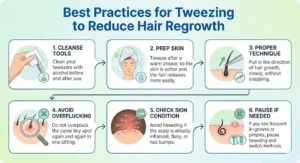
Here are practical habits that can help you tweeze more safely and avoid making regrowth look worse:
- Clean your tweezers with alcohol before and after use
- Tweeze after a warm shower so the skin is softer and the hair releases more easily
- Pull in the direction of hair growth, slowly, without snapping
- Do not overpluck the same tiny spot again and again in one sitting
- Avoid tweezing if the scalp is already inflamed, flaky, or has bumps
- If you see frequent in-growns or pimples, pause tweezing and switch methods
Conclusion
Tweezing hair on the head usually does not reduce growth permanently. In most cases, it simply removes one hair from the root and the follicle makes another one. That is why regrowth can feel slower compared to shaving, and why the area can look temporarily less dense, especially if you keep plucking the same spot.
Too much pulling can irritate the scalp, cause recurring bumps, and slowly weaken follicles over time. If you want to keep your scalp calm while hair grows back, focus on gentle aftercare and consistent moisture. For an easy daily step, try Dr. Boogie Secrets and use Dr. Boogie Bionic Hair and Scalp Oil between tweezing sessions to soothe dryness, support scalp comfort, and help hair look healthier as it comes in.