When you are searching for natural hair care tips and tricks on the internet, walnuts keep popping up as a food for stronger, better-for-you hair. What does the science actually say about this nutrient-dense nut and your hair?
The reality is more complicated than it appears in many social media posts. Although Walnuts are undoubtedly packed with a range of nutrients that really do help improve hair’s overall health.
Knowing the difference between supporting our existing hair and developing new strands of hair is essential. This detail is crucial because it helps you form realistic expectations about what dietary changes can do for your hair and what they can’t.
In this in-depth guide, we’ll take a close look at the actual connection between walnuts and hair health, including what’s beneficial and where the hype may fall short. You will see which exact nutrients in walnuts contribute to the health of your hair, how these nutrients function in the body, and why you won’t be able to turn back time on dormant follicles or avoid looking after your scalp with diet alone, no matter how great that diet may be.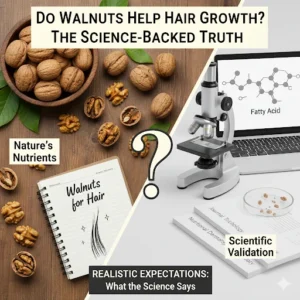
The Nutritional Profile of Walnuts and Its Relevance to Hair
Walnuts are unique among nuts due to their nutrient profile, particularly their omega-3 fatty acid content. One ounce of walnuts (about 14 halves) is an ideal amount for daily snacking.
Omega-3 Fatty Acids (Alpha-Linolenic Acid)
Walnuts are also among the plant’s richest sources of ALA, an essential omega-3 fatty acid that the body does not produce. One ounce delivers about 2.5 grams of ALA. Such fatty acids are necessary for the health of cell membranes, including those in your scalp and hair follicles. They manage inflammation and support the sebaceous glands in your scalp, which produce natural oils, maintaining your hair moisturized and protected.
Biotin (Vitamin B7)
Walnuts aren’t the richest source of biotin; that title goes to foods like eggs or liver, but they still add to your day’s total intake. Biotin is often linked to hair health because of its role in the synthesis of keratin, the protein that makes up your hair shafts and strands. A deficiency of biotin can cause brittle hair and hair loss, but actual deficiencies are uncommon among people who eat a varied diet.
Vitamin E
Another excellent antioxidant, walnuts are high in gamma-tocopherol, , a type of vitamin E. Why this is important for hair health: Oxidative stress (free radicals derived from UV exposure, pollution, and even normal metabolic processes) can harm hair follicles and contribute to premature hair aging. Vitamin E can counter those free radicals, which can be harmful and may help protect from crowded surroundings.
Zinc
Zinc aids in protein synthesis and cell division, both of which are necessary for the hair growth cycle. Your hair follicles are among the fastest-dividing cells in your body, and they need a lot of zinc to grow. Zinc deficiency can cause hair loss, but popping zinc doesn’t prevent or reverse slow growth that isn’t associated with a deficiency.
Protein Content
Walnuts offer about 4 grams of protein per ounce. As hair is nearly all protein (a relative of the amino acid cysteine), sufficient dietary protein provides the building block needed to grow and replace hair. But most people in developed countries eat enough protein, and extra protein from walnuts is more supportive than transformative.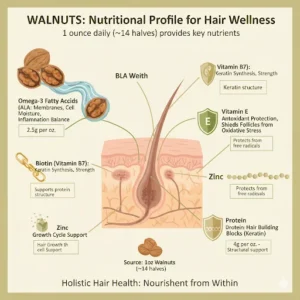
Daily Walnut Intake and Hair Wellness Balance
Knowing how many walnuts to eat for healthy hair is a matter of weighing. Most studies on nut consumption have explained that one serving per day (or 1-1.5 ounces, which is generally equivalent to 14–21 walnut halves) supports a nutritionally-dense regime without causing weight gain due to the additional calories.
This size offers about 185–280 calories, 2.5 — 3.75 grams of omega-3 ALA, 4–6 grams of protein,, and trace minerals such as vitamin E, copper,, and zinc. For your hair, this daily portion of the food provides a nutritional baseline to keep your hair follicles healthy over time, so you don’t have to eat walnuts and ignore other deliciously nutrient-dense foods.
But when it comes to hair biology, repetition counts for far more than volume. Hair grows in cycles, and the anagen (growth) phase can last anywhere from 2 to 7 years; therefore, nutritional interventions must be maintained for months to produce visible changes in hair quality. A daily palmful of walnuts adhered to for two or three consecutive months is more likely to influence the health of your hair.
Where Walnuts Support Hair Retention Instead of Growth
Hair retention is about preventing hair loss early and keeping what you have healthy. First of all, your hair is bound to fall out on its own—50-100 strands a day is extremely normal as part of the hair growth process. Retention is attempting to stop as much shedding beyond that bare minimum level and to ensure that hair grows and doesn’t just break off before it reaches its full length.
Hair Retaining Property in Walnuts. There are numerous ways through which walnuts help to retain your hair:
- Reducing Inflammation-Related Shedding
Continual scalp inflammation can disrupt the hair growth phase and force additional follicles into a loss phase (shedding) well before their time. Walnut’s omega-3s have anti-inflammatory actions that can contribute to a healthier scalp environment, ultimately lessening over-shedding induced by inflammation.
- Strengthening the Hair Shaft
The presence of protein, biotin, and vitamin E in walnuts helps build hair shafts. Stronger hair is less likely to snap, which means hair growing from your follicles has a better chance of reaching its full length before it naturally falls out. And this is especially applicable to those with textured or curly hair, as it’s far more fragile than straight hair.
- Supporting Sebum Production
The omega-3 fatty acids that are found in walnuts aid in your body’s production of sebum, the natural oil our scalp makes. Enough sebum will ensure your hair is well-moisturized and protected from environmental damage. Dry, brittle hair can break more easily,, which cuts down on your functional hair length , even if follicles are creating hair at a normal rate.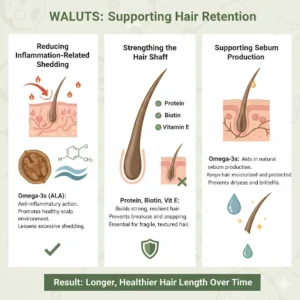
Nutrition Alone Cannot Reactivate Dormant Hair Follicles.
This is perhaps the most crucial section of this entire article because it addresses a fundamental misunderstanding about how hair loss works and what nutrition can realistically accomplish.
Understanding Hair Follicle Dormancy
Hair follicles don’t simply “die” in most types of hair loss. Instead, they miniaturize and eventually go dormant. In androgenetic alopecia (pattern hair loss), which affects both men and women, the hormone DHT (dihydrotestosterone) causes susceptible follicles to shrink gradually. These miniaturized follicles produce progressively thinner, shorter hairs until they eventually stop producing visible hair altogether and enter a dormant state.
Why Nutrition Cannot Reverse This Process
Dormant follicles remain in your scalp but have turned off their growth programming. No amount of dietary improvement, including adding walnuts or other nutrient-rich foods, can reactivate these follicles because the issue isn’t a nutritional deficiency. The follicles have adequate access to nutrients through your bloodstream; they’ve simply stopped responding to the signals that initiate hair growth.
Think of it this way: providing more fuel to an engine deliberately switched off won’t make it run. The follicles require interventions that can override or counteract the hormonal signals driving miniaturization, such as minoxidil (which extends the growth phase and may reactivate some follicles) or finasteride (which blocks DHT production).
When Nutrition Makes a Difference
Nutrition becomes highly relevant in hair loss only when deficiency is the actual cause:
- Telogen Effluvium from Severe Dieting: Rapid weight loss or severely restricted eating can push large numbers of follicles into the shedding phase simultaneously. In these cases, restoring adequate nutrition (including foods like walnuts) can allow follicles to return to regular cycling.
- Iron Deficiency: Low iron stores are associated with increased hair shedding. While walnuts aren’t a significant source of iron, correcting iron deficiency through diet or supplementation can reduce shedding.
- Protein Malnutrition: In cases of severe protein restriction, the body prioritizes protein for essential functions over hair growth. Restoring adequate protein intake (including the protein in walnuts) allows hair growth to resume.
Why External Scalp Nourishment Completes the Hair Growth Picture
Even though internal nutrition provides the nutrients needed to support healthy hair growth, the scalp environment where hair is actually formed deserves its share of attention. Here is where the external care comes into play.
The Scalp’s Unique Challenges
Your scalp has its own obstacles that won’t be solved just with internal nutrition:
Environmental Harm:
Sun, dirt, and other weather conditions can have a noticeable effect on your scalp and hair shaft. Walnut antioxidants are therefore systemically engaged with scalp tissue, possibly not sufficiently enriched in antioxidant activity to completely block external oxidative stress.
Product Buildup:
After a while, all of those hair products + stylers + even dry shampoo can leave your follicles congested and your scalp an unfriendly place. The plaque is something that diet alone cannot eradicate.
Microcirculation:
The little blood vessels that feed your hair follicles may be enhanced by local topical massage and ingredients that can help local circulation, something that diet alone doesn’t address directly.
Moisture and Protection directly:
The hair shaft itself, once it has grown out, is essentially dead tissue. It needs something from the outside to moisturize and protect it.
Internal and External Care Work Together
Consider hair health like the prep work and finishing that goes into painting a wall:
Internal nutrition (including walnuts) is the foundation of the structure and overall health that enable follicles to function at their best, producing strong, healthy hair.
External scalp care finishes the job, providing direct support to the scalp environment and protection of the hair shaft, and targeted interventions that nutrition cannot achieve.
What Should Be Included in External Scalp Care
An entire scalp care routine includes:
Cleansing:
Frequent washing away of buildup, excess body oil, and dead skin cells that might block hair follicles
Nourishment:
Oiling the Scalp or using Serums/Solutions that help keep the scalp and hair healthy and strong.
Preservation:
Formulas that protect hair from the factors that cause wear and tear , UV exposure, heat styling, and environmental aggressors
Stimulation: A light massage, which helps the blood flow and possibly aids follicle health
Hydration: Moisturizing agents to maintain scalp and hair shaft hydration.
Pairing Nutrient Support With a Premium Scalp Oil Ritual
To reach the full potential of nutritive interventions, such as adding walnuts to your diet, you need to combine them with targeted external scalp care for a visible effect. Walnuts will provide the inside hair with building materials, including omega-3 fatty acids and other minerals.
Including essential fatty acids and botanical extracts, these compounds cross the body’s natural blood-brain barrier and deliver nutrients directly to your scalp tissue for a more immediate effect.
This method only works if you have a good product. High-quality products, such as Dr. Boogie’s Hair Scalp Oil,, contain very light carrier oils like jojoba or argan that absorb deeply into the skin without leaving a heavy, greasy film on the scalp and hair.
These are commonly enriched with bioactive botanicals and antioxidants, such as Vitamin E , to help defend against oxidative damage. For optimal results, make it a regular ritual: massage the oil directly onto the scalp 2 to 3 times per week; after application, spend 5 to 10 minutes lightly massaging your scalp in circular motions.
This is not a magical process, even if you start with the right combination of walnuts and professional-grade oils. Biology just takes its time; you generally have to use it between 3-6 months in a row before what looks like the same regimen starts giving out tangible improvement, potentially qualities, strength, and retention.
It’s also worth noting that these habits maximise your hair within your genetic potential, but they are not instant fixes. The objective is to build a thriving environment where your hair can grow at its strongest, healthiest, and most resilient natural pace.
The Celebrity Hair Care Philosophy: Balance Inside & Out
Truly healthy hair comes from a combination of proper nutrition and consistent scalp care.
Even a perfect diet with walnuts, proteins, and essential nutrients can result in dry, dull hair
if the scalp isn’t nourished and protected. Likewise, premium hair products alone cannot
overcome nutritional deficiencies. Dr. Boogie’s Bionic Hair and Scalp Oil works alongside your
internal support to create stronger, softer, and healthier hair.
Conclusion
Walnuts provide genuine nutritional support for hair health through their omega-3 fatty acids, biotin, vitamin E, copper, zinc, and protein. These nutrients support the biological processes that keep hair follicles healthy and hair shafts strong. A daily serving of 1-1.5 ounces can contribute to better hair retention, reduced breakage, and overall hair wellness when consumed consistently as part of a balanced diet.
However, walnuts cannot single-handedly transform your hair, accelerate growth beyond your genetic baseline, or reactivate dormant follicles affected by pattern hair loss. They cannot replace medical treatment for underlying conditions causing hair loss, nor can they overcome the damage caused by harsh styling practices or environmental stress without corresponding external care.
By understanding both what walnuts can do (support existing hair health and retention) and what they cannot do (reactivate dormant follicles or dramatically accelerate growth), you can set realistic expectations and create a comprehensive hair care strategy that addresses both internal nutrition and external scalp nourishment.