Scroll through TikTok or YouTube, and you might find someone hanging upside down from their bed, insisting it’s the key to growing hair really quickly. The theory is uncomplicated: Turn yourself upside down to encourage blood flow to the scalp, and you’ll soon see your hair grow inches in just a week. But does this viral trend really work, or is it another beauty myth that’s simply too good to be true?Does Standing Upside Down Help Hair Growth? – Necole Bitchie
The theory that flipping your body upside down could stimulate hair growth has circulated among beauty communities for years, and it recently exploded across social media with dramatic before-and-after claims. The appeal here is obvious: It’s free, it’s natural, and you don’t have to spend a penny or treat anything outside your apartment for quick results. But if we look at the physiology of hair growth and circulation, the truth is very far from the hype.
We’re going to unpack the science, debunk some myths, and figure out what really lends a helping hand when it comes to growing lustrous locks.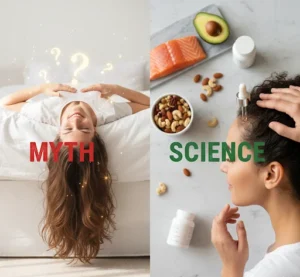
The Concept of Being Upside Down
The act of flipping your body upside down, whether it’s in headstands, hanging off the side of your bed, or on an inversion table, has its origins in various wellness traditions. Yoga practitioners have practiced inverted poses such as headstands (Sirsasana) and shoulder stands (Sarvangasana) for centuries, touting benefits including enhanced circulation, mental clarity, and stress reduction. When it comes to hair growth, the idea was that inverting your head so your head is below your heart would put gravity to work for you. The idea is that when you stand up, the blood has to work against gravity to reach your scalp.
But when you turn upside down, gravity starts to work in your favor momentarily, pushing blood toward the blood-hungry root of each hair follicle and flooding your scalp with oxygen and nutrients that are supposed to stimulate dormant hair follicles into action and shorten growth.
The basic premise sounds logical:
- Upright position = blood pulled away from scalp (by gravity)
- Headstand position = gravity forces blood toward the scalp
- Additional blood = more oxygen and nutrients to the follicles.
- More minerals = quicker, denser hair growth.
Upside-Down Positions and Hair-Related Claims
The Standard Inversion Method Protocol:
Prepare: Put warm oil on your scalp. (Traditionally, common oils are warm coconut, olive, castor, or a combination )
Massage: Use your fingers to massage the oil into your scalp, working in circular motions for 5-10 minutes
Invert: Either flip head down, bending forward at the waist, or go all in (a full do-able one) if you can, into a headstand
Hold: Hang upside down for 4-7 minutes (one model says strictly 4 minutes, no longer)
Press: Slowly return to standing position.
Repeat: Do 7 days in a row, then rest of the month off.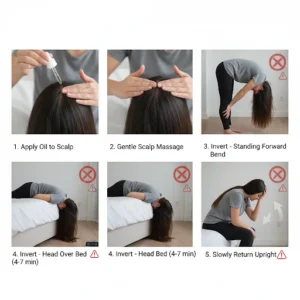
The crucial thing is this: Although these feelings are real, we’re misreading them. A tingling scalp does not indicate that your dormant hair follicles are suddenly springing into action and growing hair at 10. It just tells you that blood pressure in your head has spiked, which your body will restore to equilibrium in minutes. The sensation that something is happening does not correlate with hair growth.
Blood Circulation and Scalp Health
To understand why the inversion method doesn’t pan out, you’ve got to understand what really happens in your blood circulation when you flip upside down and what hair follicles actually want.
What Your Heart Really Looks Like in Action
My point is that your cardiovascular system is incredibly complex, far more complicated than mere water running through pipes. It is not dependent only on gravity to send blood around; if it were, giraffes would be nonexistent, and every time you stood from lying down, you’d faint.
Key facts about circulation:
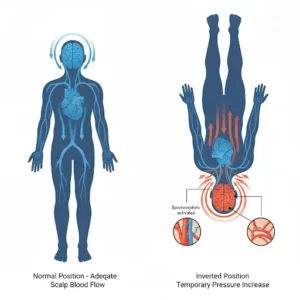
Would you believe that, in the normal functioning of a healthy body, the blood pumped by your beating heart can travel to every part of your body, including your scalp, no matter what position you are in? Blood pressure is dynamically regulated by a host of sensors and responses that constantly adjust the diameter of your blood vessels or speed up your heart rate to maintain steady flow to essential organs (such as your brain and scalp).
When you stand upright:
- The position of change is sensed by baroreceptors (pressure sensors).
- When you’re standing, blood vessels in your legs tighten to maintain adequate blood pressure. You will have a slightly elevated heart rate.
- Veins in your body contain valves that prevent blood from pooling in your lower body.
- Blood is still well delivered to your scalp.
When you flip upside down:
- Blood does temporarily pool in your head and upper body
- You get a momentary increase in blood pressure in your head
- Your body elicits a series of compensatory responses to avoid dangerous pressure accumulation
- Heart rate can even drop (part of the diving reflex).
- Vasospasm may cause vessels to narrow, restricting blood flow over long distances.
- And within a few minutes, your body has adapted to the situation.
The Effects of Inversion on Hair Follicles
To truly understand why standing upside down doesn’t stimulate hair growth, we need to look at how hair follicles actually function and what controls their activity.
The Hair Growth Cycle Explained
Every single hair follicle on your scalp operates independently on a genetically predetermined cycle with three distinct phases:
Anagen (Active Growth Phase):
- Duration: 2-7 years (varies by genetics and body location)
- What happens: The follicle actively produces hair from rapidly dividing cells in the hair matrix
- Percentage: About 85-90% of your scalp hairs are in this phase at any given time
- This is the only phase when hair is actually growing longer
Catagen (Transition Phase):
- Duration: About 2-3 weeks
- What happens: Cell division stops, the follicle shrinks, and the hair detaches from its blood supply
- Percentage: Only about 1-3% of hair is in this brief phase
- A transitional state between growth and rest
Telogen (Resting Phase):
- Duration: About 3 months
- What happens: The hair remains in place but isn’t growing; a new hair begins forming beneath it
- Percentage: About 10-15% of hairs are in this phase
- At the end of telogen, the old hair sheds, and a new anagen phase begins
This cycle continues throughout your life, which is why you naturally shed 50-100 hairs per day while simultaneously growing new ones.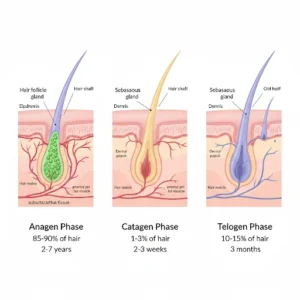
The Disconnect: Blood Flow vs. Follicle Activation
Even if we accept that standing upside down temporarily increases blood flow to your scalp (which it does, slightly), this doesn’t translate into any of the following:
- Follicles switching from telogen (resting) to anagen (growth) phase
- The anagen phase lasts longer than its genetic programming
- Faster cell division in the hair matrix
- Increased hair shaft diameter
- Activation of truly dormant follicles (which are typically dormant due to hormonal factors, not lack of blood)
- Overriding genetic limitations on growth rate
Hair follicles aren’t sitting idle, waiting for a blood delivery to arrive so they can spring into action. They’re actively regulated by sophisticated signaling systems that operate on timescales of weeks, months, and years not minutes.
Temporary Sensations vs Long-Term Hair Results
One of the main reasons the inversion myth persists is that people genuinely feel dramatic sensations when they hang upside down. These sensations seem significant, leading people to believe something must be working. Let’s decode what you’re actually experiencing.
What Those Sensations Really Mean
The tingling or “buzzing” feeling:
When you flip upside down, the blood pressure in the tiny vessels (capillaries) of your scalp may increase. Nerve endings sense this change in pressure and send a signal to your brain, which you perceive as tingling. It’s a similar kind of sensation to the feeling you get when your foot falls asleep due to poor circulation, but experienced in reverse.
This tingling is a superficial sensation involving the skin and muscles. It does not penetrate deeper into the skin where hair follicles live, and it certainly doesn’t make a follicle start growing hair or boost hair production. The feeling passes shortly after you are back right-side up and blood flow returns to normal.
Why False Hope Is Harmful
At the same time, there is real harm in believing in ineffective methods. It leads to:
Time and energy waste: Let’s face it, the time spent on the inversion method could be better spent practicing methods that really do work.
Disappointment and frustration: When the results that are promised don’t come to pass, people can feel like they’ve been misled and potentially give up on hair care altogether
Injury risk: Inversions, particularly those performed incorrectly or by people with certain health conditions, may lead to falls, neck strain, and cardiovascular problems.
Withheld treatment: Sufferers of actual hair loss conditions, such as androgenetic alopecia, telogen effluvium, or alopecia areata, may avoid seeking appropriate medical treatment and waste time on ineffective home remedies.
Financial exploitation: The practice has become so widespread that products sold specifically for inversion therapy pillows, benches, oils, and supplements are advertisements aimed at our hopes.
Standing Upside Down as a Hair Growth Myth
Let’s state it clearly and definitively: the hair-growth inversion method is a myth. Here’s why we can say this with confidence.
Zero Scientific Evidence
Although inversion exercises have been popular for years, and there are thousands of testimonials on the web attesting to their efficacy, there are no scientific, peer-reviewed studies showing that they actually promote hair growth.
But there is no evidence whatsoever in this research to support the idea that dangling your head upside down will make your hair grow.
If the effects were genuine, especially if it were as remarkable as advertised (1-2 inches in a week, or 4-8 times faster than the normal rate), it would have been investigated to death. Drug companies, dermatologists, and hair-replacement companies would have tested and approved it. The lack of any reputable studies says it all.
What Actually Supports Healthy Hair Growth
Now that we’ve thoroughly debunked the inversion myth, let’s focus on what genuinely promotes healthy hair growth. The truth may be less exciting than a quick trick, but it’s far more effective and based on actual science.
Nutrition: The Foundation of Hair Health
Your hair is approximately 95% keratin, a structural protein. Without adequate nutrition, your body literally cannot build strong, healthy hair. Essential nutrients for hair include:
- Protein: Since hair is primarily protein, adequate dietary protein is crucial. Aim for 0.8-1.0 grams of protein per kilogram of body weight daily from varied sources: lean meats, fish, poultry, eggs, dairy, legumes, nuts, and seeds.
- Iron: Iron deficiency is one of the most common nutritional causes of hair loss, particularly in women. Iron is essential for producing hemoglobin, which carries oxygen to cells, including follicles. Low iron even without full anemia can trigger excessive shedding. Sources include red meat, dark leafy greens, lentils, fortified cereals, and pumpkin seeds. Pair iron-rich foods with vitamin C to enhance absorption.
- Biotin (Vitamin B7): While true biotin deficiency is rare, this B vitamin plays a role in keratin production. Found naturally in eggs, almonds, sweet potatoes, spinach, and avocados.
- Zinc: Essential for hair tissue growth and repair, and for the proper functioning of oil glands around follicles. Deficiency can cause hair loss. Best sources: oysters, beef, pumpkin seeds, lentils, and quinoa.
- Omega-3 fatty acids: These healthy fats support scalp health, reduce inflammation, and help hair maintain strength and elasticity. Found in fatty fish (salmon, mackerel, sardines), walnuts, flaxseeds, chia seeds, and algae-based supplements.
- Vitamin D: Receptors for vitamin D are present in hair follicles, and deficiency has been linked to hair loss conditions like alopecia areata and telogen effluvium. Sources include sunlight exposure, fatty fish, egg yolks, and fortified foods.
- Vitamin A: Necessary for cell growth and sebum production (scalp oil), but too much can actually cause hair loss. Best obtained from food: sweet potatoes, carrots, spinach, and kale.
- Vitamin E: A powerful antioxidant that protects hair and scalp from oxidative stress. Found in sunflower seeds, almonds, spinach, and avocados.
- B-Complex vitamins: B12, folate, niacin, and others support red blood cell production and cellular energy both crucial for hair growth. Found in whole grains, meat, eggs, and leafy greens.
Why Hair Growth Requires More Than Body Position
Hair growth is a complex biological process that involves genetics, hormones, cellular signaling, and sustained nutritional support. It operates on a timescale of months and years, not minutes.
1-The Genetic Blueprint
Your genes determine:
- How long your anagen phase lasts (which controls maximum hair length)
- How thick each hair strand can become
- How many follicles do you have per square inch
- Your hair’s texture and curl pattern
- Your susceptibility to pattern baldness
No amount of hanging upside down, applying oils, taking supplements, or using special products can override your genetic programming. This is why hair that grows past your waist is more about genetics and retention than about any special routine.
2-The Hormonal Orchestra
Hormones are master regulators of the hair cycle:
- Androgens (testosterone and DHT) can shorten the anagen phase and miniaturize follicles in genetically susceptible people.
- Thyroid hormones regulate metabolism in follicle cells; imbalances cause diffuse thinning or loss.
- Estrogen extends the anagen phase (which is why pregnant women often have thick hair, and why postpartum shedding occurs)
- Cortisol (stress hormone) can disrupt the cycle and trigger shedding.
- Insulin and IGF-1 influence follicle activity and growth
These hormonal influences operate constantly, 24/7, on a cellular level. A few minutes of altered blood flow cannot counteract or enhance these powerful regulatory systems.
3-The Nutritional Foundation
Hair follicles are among the most metabolically active tissues in your body. They require a constant supply of:
- Amino acids (protein building blocks)
- Energy (from calories/carbohydrates)
- Vitamins and minerals for enzymatic reactions
- Fatty acids for cell membrane structure
- Antioxidants to protect from oxidative damage
These nutrients must be delivered consistently through your bloodstream, which already happens efficiently in a healthy person, regardless of body position. The limitation is rarely delivery; it’s usually supply (what you eat) or demand (what your follicles are programmed to do).
4-The Time Factor
Perhaps most importantly, hair growth requires TIME. There are no shortcuts to biological processes that are inherently slow:
- Cell division in the hair matrix happens at a specific rate
- The newly formed cells must migrate upward
- They must differentiate and fill with keratin
- They must harden and form the hair shaft structure
- This process produces visible growth at roughly 0.5 inches per month
No position, product, or practice can fundamentally accelerate this intricate, genetically programmed process. Patience and long-term consistency are essential.
Dr. Boogie Hair Oil for Stronger and Healthier Hair
If you’re wondering what truly makes a difference in your hair’s health and appearance,
the answer is consistency and the right support. Dr. Boogie’s Bionic Hair and Scalp Oil
is not a miracle cure, but a thoughtfully formulated blend of multiple ingredients that
helps create the kind of scalp environment where healthy hair can thrive. Used regularly,
it works as a steady partner in your routine to support strength, balance, and shine.
Conclusion
The hair inversion method is an enticing myth: free, natural, and promising quick results. So, when we consider the real biology behind hair growth and blood flow, it’s clear that standing on your head is just about the last thing you can do to keep your braids from zee-rot.
Hair growth is a difficult, genetically programmed dynamic process under hormonal, nutritional, general health, and time-related control. It occurs on a time frame of months and years, rather than minutes. Under normal circumstances, your scalp receives enough blood. Pumping up the flow of that for a few minutes does not outdo genetic programming, turn on dormant follicles, or speed up the hair growth cycle.
The sensations that people feel during inversion, tingling, warmth, and pressure are real but misunderstood. These sensations are actually the result of temporary shifts in blood pressure and circulation, not hair follicle activation or hair growth.