When you look at your brush, or the pillow in the morning, or down the drain in the shower, and thought, That’s a lot of hair, you’re not alone. But then an old thought comes to mind: hair fall is actually healthy; it’s a sign of new growth, since every time a strand falls out, it opens up space for new, fresh hairs to move in and take root.
Does hair loss mean that hairy days are ahead? The answer is much more complex than a simple yes or no. Hair loss is normal as part of the hair growth cycle, but not all thinning leads to regrowth. Learn how to distinguish natural shedding from problematic hair loss, and how to care for your scalp when the latter is occurring, so you can keep your hair as healthy as possible.
In this comprehensive guide, we’ll examine the hair growth cycle, explain how to differentiate between normal and potential problem shedding for both men and women, and tell you what Hair fall normally looks like when it’s good news concerning renewal, or how you can fortify your scalp against an influx of shedding.
Understanding the Natural Hair Growth Cycle
To understand whether hair fall means new growth, you first need to understand how hair actually grows. Every single hair on your head goes through a predictable cycle with distinct phases.
The Anagen Phase (Growth Phase)
This is a stage during which hair grows actively for 2 to 7 years, depending on genetics. In anagen, there is rapid cell division in the hair follicle (producing the long part of the hair) and a pushing upward and outward from within. The more time you spend in anagen, the longer your hair can grow. These hairs on your scalp make up about 85-90% of the total in this phase at any time.
The anagen phase is the growth phase of your hair. If your anagen phase is just 2-3 years, that could indicate that your hair length will peak at shoulder length. If you have a 6-7-year anagen phase in your genes, that is all the time needed to grow waist-length hair, or even longer.
The Catagen Phase (Transition Phase)
This short transition lasts just 2-3 weeks. In catagen, active growth ends, and the hair follicle begins to shrink. At the base of the follicle, a hair root is severed from its blood supply and pushed out of the shaft by new cells. In this process, the follicle prepares for hair release and resets itself for a new cycle. The anagen phase is the active growth phase, accounting for only 1-2% of hairs on the scalp at any given time.
The Telogen Phase (Resting Phase)
The telogen phase lasts about 3 to 4 months. The hair has no blood supply, but the root is connected to blood vessels in the scalp. Meanwhile, new hair starts growing in the follicle under the old one. Eventually, the new hair nudges the old one out, and you notice it falling while brushing, during your hair wash or even on its own. At any given time, 10-15% of your hair is in the telogen phase.
The Exogen Phase (Shedding Phase)
Some experts classify exogen as a distinct phase, whereas others include it in telogen. This is when the real shedding takes place: the old hair falls out of the scalp as new hair, still attached to the body, grows underneath it. Under normal conditions, humans lose 50 to 100 hairs daily as part of the natural hair loss process.
Common Causes of Hair Fall
Not all hair fall happens for the same reasons. Understanding what’s causing your hair to shed helps determine whether new growth is likely.
- Normal Daily Shedding
The 50 to 100 hairs you lose daily just had their day. These hairs developed over the course of years, underwent catagen, and rested in the telogen stage before ultimately shedding to accommodate new growth. This kind of hair loss is perfectly normal and even beneficial.
- Seasonal Shedding
Many people experience seasonal hair fall, especially in late summer and early fall. One possibility suggested by research: this is an evolutionary relic, with a logic we no longer understand.
- Post-Pregnancy Hair Loss
The increased levels of estrogen during pregnancy prevent more hairs than normal from entering the catagen and telogen phases, so your hair appears fuller. Postpartum, women’s hormones return to normal, and all those extra hairs that were stuck in the growing phase shift into telogen and fall out at once. This is known as postpartum telogen effluvium, and although it can be disconcerting, it’s transient. Hair growth resumes once hormones return to normal.
- Stress-Related Shedding (Telogen Effluvium)
A physical or emotional shock, illness, rapid weight loss, surgery, high fever or a death in the family can cause large numbers of hairs to enter the resting phase all at once. After 2-3 months of this burst, you will start to notice hair fall. The positive note is that once the trigger of telogen effluvium is out of the way, it’s generally reversible, and hair growth usually takes 6-12 months to kick in.
- Nutritional Deficiencies
A lack of protein, iron, biotin, and zinc can disrupt the hair growth cycle. Iron deficiency is common in women and can lead to diffuse hair shedding. Growth generally returns to normal when the deficiency is treated.
- Hormonal Changes
Hypothyroidism, PCOS, menopause and other hormonal imbalances can cause hair loss. Some lead to temporary shedding (with a chance of regrowth), while others (such as androgenetic alopecia/pattern baldness) are characterised by progressive follicular miniaturisation.
- Medication Side Effects
Some drugs, such as antidepressants, blood thinners and blood-pressure or acne medications, can trigger hair loss as a side effect. Hair usually grows back when the medicine is stopped or the dose is adjusted.
The Difference Between Hair Shedding and Hair Loss
This is crucial: shedding and hair loss are not the same thing, even though the terms are often used interchangeably.
1-Hair Shedding (Telogen Effluvium)
Characteristics:
- Temporary increase in daily hair fall (more than 100 hairs per day)
- Diffuse thinning across the entire scalp
- Usually triggered by a specific event (stress, illness, hormonal change)
- Hair follicles remain intact and capable of producing new hair
- Regrowth typically occurs once the trigger is resolved
Prognosis: Excellent. The follicles are still healthy and will produce new hair once they cycle back into anagen.
2-Hair Loss (Anagen Effluvium or Androgenetic Alopecia)
Characteristics:
- Progressive thinning or bald patches
- Pattern-specific loss (receding hairline, crown thinning in men; widening part in women)
- May involve follicle miniaturisation (follicles shrink and produce finer, shorter hairs)
- It can be permanent if follicles become completely dormant
- Often requires medical intervention for regrowth
Prognosis: Variable. Some types respond to treatment; others result in permanent hair loss.
The critical difference: with shedding, the follicle is temporarily disrupted but remains capable of growth. With progressive hair loss, the follicle itself may be damaged or miniaturised, potentially losing its ability to produce normal hair.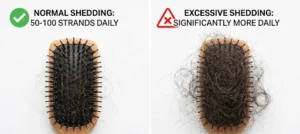
When Hair Fall Is Linked to New Hair Growth
So, when does hair fall actually signal incoming new growth?
Normal Cycling
During the hair growth cycle, a new anagen hair is already forming beneath it in a normal follicle, while a telogen hair is shed. You can’t see this new hair yet; it’s only just starting its way down the follicle, but it is there. This is the most common situation, and it is where the apparent dichotomy between hair fall and new growth arises.
Post-Telogen Effluvium Recovery
Throughout the hairline and scalp, you may see these short, wispy hairs start to regrow. These are the newer hairs that had just started growing when the telogen phase of hair growth ended. This regrowth usually starts appearing 3-6 months after shedding and is a very good sign of getting back to normal.
Seasonal Transition
If you suffer from fall shedding, you’ll probably experience new growth in winter and spring. You may feel like you’ve lost some hair when this happens, but the filling in and thickening of your mane will make up for it as new strands start to grow.
After Correcting Deficiencies
Once you address the nutritional deficiencies or hormonal imbalances that are causing your hair loss, new growth can occur within a few months.
Signs of Healthy Regrowth vs Problematic Hair Fall
How can you tell if your hair fall is the healthy, cyclical kind or something more concerning?
Signs of Healthy Regrowth
- Baby hairs of varying lengths throughout the scalp, especially at the hairline, indicate active regrowth.
- New growth that’s the same thickness as your existing hair suggests healthy follicle function.
- If you experienced a stressful event, illness, or dietary change 3-4 months ago and are now shedding, this pattern is consistent with telogen effluvium, with expected regrowth.
- After an initial increase, daily hair fall returns to normal levels (50-100 hairs per day).
- Your scalp looks and feels healthy, with no redness, flaking, inflammation, or visible thinning patches.
Signs of Problematic Hair Fall
- Hair still gets thinner over months or years, rather than stabilising.
- The new growth is finer and shorter than before, as follicles shrink.
- Gradual thinning of hair at the top of the scalp, on the temples, or along a vertical part line is a sign of androgenetic alopecia.
- If you continuously feel itchy, have scalp scaling, redness, or irritation (which can happen with scalp eczema as well), it disrupts the ability of hair to grow.
- Prolonged loss should be evaluated if continued beyond 6-8 months.
- Round or oval patches of total hair loss may be a sign of Alopecia areata or other causes of hair loss.
If you’re experiencing any of these problematic signs, it’s important to consult a dermatologist or trichologist for proper diagnosis and treatment.
Factors That Disrupt Healthy Hair Regrowth
Even when hair fall is part of the natural cycle, certain factors can interfere with the regrowth phase, meaning the fallen hair isn’t replaced as expected.
Chronic Nutritional Deficiencies
If you are chronically deficient in any nutrient, especially protein, iron, zinc, or B vitamins, your follicles may not have the raw materials they need to grow new hair effectively. This can prolong the telogen phase and lead to delayed or thin regrowth.
Ongoing Stress
Prolonged psychological or physical stress, as cortisol levels rise, extends telogen and causes a brief increase in shedding rate. This has the effect of more hairs in the resting/shedding phase and fewer in the growth phase.
Hormonal Imbalances
Untreated thyroid disease, PCOS or some other endocrine problems can throw a pull into the hair cycle that never works itself out. Without resolving the original hormonal issue, there may be minimal or no regrowth.
Inflammation and Scalp Conditions
Long-term scalp inflammation, as seen with seborrheic dermatitis, psoriasis, or fungal infections, is not conducive to hair growth. Inflamed follicles have a tough time growing healthy hair.
Aging
Hair growth naturally slows down as we age. In the anagen phase, your hair follicles may produce thinner hairs or enter longer resting periods. This isn’t necessarily to say hair won’t regrow, but that regrowth patterns might not be as robust as when we were younger.
The Role of Hair Oils in Hair Fall and Growth Support
Hair oils have been a tradition for hundreds of years across various cultures to promote a healthy scalp and encourage strong hair. Although they cannot reverse genetic hair loss or overcome severe nutritional deficiencies, they can create an optimal environment for new hair growth, especially during temporary shedding periods.
Your hair is consistently treated with high-quality oils that deliver vital omegas, nutrients and antioxidants to encourage healthy hair growth. And when massaged into the scalp, oils can also stimulate blood circulation, thereby enhancing the flow of oxygen and key nutrients to the roots. They also help maintain the proper moisture balance, protecting against dryness and flaking that can impair healthy hair growth.
Most botanical oils have anti-inflammatory properties that help calm inflammation and create a healthier scalp environment. Oils create a barrier on the hair, helping protect it from environmental damage and breakage, so that when your hair grows in, you’re able to keep its length and strength.
Selecting the Right Hair Oil
Not all hair oils are created equal. Look for formulations that:
- Contain proven botanical ingredients with anti-inflammatory or growth-supportive properties.
- They are lightweight enough to absorb without leaving heavy residue
- Include ingredients that address your specific scalp concerns (dryness, inflammation, thinning)
- Come from reputable manufacturers with quality control standards.
Why Hair Fall Does Not Automatically Guarantee New Growth
This is the sobering truth: while the natural hair cycle includes the built-in shedding and replacement of hair, several conditions can disrupt this cycle.
Androgenetic Alopecia (Pattern Baldness)
In genetically predisposed individuals, hair follicles are sensitive to DHT, a hormone that causes progressive follicle miniaturisation. Each cycle, the follicle produces a slightly finer, shorter hair until eventually it may stop producing visible hair altogether. In this case, hair fall doesn’t lead to equivalent regrowth—each new hair is weaker than the last.
Scarring Alopecia
Certain inflammatory conditions can permanently damage hair follicles, replacing them with scar tissue. Once a follicle is scarred, it cannot produce new hair. Fallen hairs from scarred follicles will not be replaced.
Prolonged Telogen Effluvium
While most cases of telogen effluvium resolve within 6-8 months, some cases become chronic. Without addressing the underlying trigger, the excessive shedding can continue indefinitely, and regrowth may not keep pace with hair loss.
Traction Alopecia
Repeated tension from tight hairstyles can permanently damage follicles. Early intervention can reverse traction alopecia, but prolonged traction may lead to permanent follicle loss.
Severe Nutritional Deficiency
Extreme caloric restriction, eating disorders, or malabsorption disorders can shut down hair growth entirely. Without adequate nutrition, follicles may remain in telogen indefinitely, with minimal to no regrowth.
Support Your Scalp During Hair Shedding
During periods of hair shedding, whether stress-related or part of the natural cycle,
consistent scalp care can make a difference in how your hair looks and feels over time.
Dr. Boogie’s Bionic Hair and Scalp Oil is formulated to nourish the scalp, restore
moisture, and strengthen fragile strands without heaviness. Its blend of botanical oils
helps support a balanced scalp environment, reduce dryness, and minimize breakage so
new growth has the best chance to reach visible length. Used regularly, it works as a
supportive part of a long-term hair wellness routine.
Conclusion
In a healthy, functioning hair growth cycle, the answer is yes every hair that completes its life cycle and falls out has already been replaced by a new hair beginning its journey in that same follicle. This is the natural order of things, the constant renewal that keeps your hair full and vibrant throughout your life.
But the relationship between hair fall and regrowth isn’t automatic or guaranteed. Disrupted cycles due to stress, nutritional deficiencies, hormonal imbalances, or genetic factors can disrupt the expected pattern. Some hair loss involves progressive follicle damage that prevents adequate regrowth, while other types represent temporary shedding with excellent prospects for recovery.
The key is understanding what type of hair fall you’re experiencing:
- Normal daily shedding (50-100 hairs) with no noticeable thinning: healthy cycling with ongoing regrowth
- Temporary increased shedding after a specific trigger: telogen effluvium with expected regrowth in 3-6 months
- Progressive or pattern-specific thinning: may indicate androgenetic alopecia or another condition requiring medical evaluation
Supporting your scalp during periods of hair fall—through nutrition, stress management, gentle care, and targeted topical treatments like Dr Boogie Hair Oil—can optimise the regrowth phase and help ensure new hairs come in strong and healthy.
Remember: hair grows slowly, and regrowth takes patience. If you’re experiencing hair fall, don’t hesitate to seek professional evaluation. A dermatologist or trichologist can diagnose the underlying cause and recommend appropriate treatment to support your healthiest hair growth.
In most cases, hair fall is simply your hair doing what it’s designed to do, making room for fresh, new growth. With the right support and care, that new growth will flourish.