Coffee is one of the most essential parts of a morning routine, so it makes sense that people would be curious about whether it could also be used to promote hair growth. The question usually emerges with something that people learn online about caffeine and hair follicles. A hair follicle guide would tell you that hair grows from follicles in cycles and relies on things like blood flow and nutrients, which already gives us the idea that hair growth is a much larger process than consuming one beverage.
There is actual science behind caffeine and hair studies, but most of the interesting information has to do with topical caffeine or lab research, not coffee consumption. This is why it is necessary to distinguish between popular claims and what has actually been proven to work for humans. Read on, and I will explain what coffee can and cannot do, as well as what actually promotes healthy hair growth.
Understanding Coffee, Caffeine, and Their Effects on the Body
Coffee contains caffeine, which is a stimulant. MedlinePlus explains that caffeine stimulates the central nervous system and can make you feel more awake, and it can also affect things like stomach acid, blood pressure, and urination.
So, when people ask if coffee promotes hair growth, they essentially want to know if caffeine affects the body in a way that promotes hair growth. Caffeine definitely affects the body in many ways, but it doesn’t do so in a hair growth-promoting manner. Feeling energized after drinking coffee doesn’t necessarily mean that your hair follicles are getting a boost for growth.
The amount of caffeine also matters. The FDA recommends that a person consume no more than 400 milligrams of caffeine per day, which is not associated with adverse effects, but sensitivity varies a lot from person to person.
Caffeine and Its Interaction With Hair Follicles
This is where the confusion lies. There are studies that show caffeine can affect human hair follicles in a lab setting. An indexed study showed that caffeine promotes the growth of hair follicles in vitro and reverses the growth-inhibiting effects of testosterone in an ex vivo model.
However, in vitro and ex vivo studies are not the same as coffee consumption and observing hair growth on the scalp. While lab studies can help scientists understand the mechanisms, they do not help scientists understand how a cup of coffee can be used as a treatment for hair loss.
Drinking Coffee vs Topical Caffeine Application
Coffee consumption versus caffeine use on the scalp are two different methods with different effects. When you consume coffee, the caffeine is absorbed into your bloodstream and works on your body as a whole. Topical caffeine, on the other hand, is researched for its ability to reach hair follicles and the scalp.
A study on shampoo application found that caffeine passed through hair follicles after topical application, which is why topical caffeine products stay popular. This is not the same as coffee consumption, where caffeine works throughout the body systemically rather than on the hair follicles.
Can Excess Coffee Contribute to Hair Thinning
Coffee itself is not a direct cause of hair thinning for everyone. Many people consume it on a regular basis without any hair-related problems. The problem is with excess coffee consumption, tolerance levels, and how it affects sleep and body comfort.
Too much caffeine can cause problems such as insomnia, tremors, headaches, and rapid heartbeat in some people, and it can also cause sleep problems, creating a vicious cycle of fatigue and more caffeine consumption.
Why does this matter for hair? Because hair shedding and thinning can be affected by stress, illness, poor nutrition, and other factors in the body. If your coffee consumption is causing sleep problems, increasing stress, or displacing healthy meals, then the indirect effect may work against healthy hair habits.
The Truth About Coffee and DHT
DHT gets discussed a lot in hair loss conversations, especially when people talk about pattern hair loss. The problem is that many online posts jump from lab ideas about caffeine to claims that drinking coffee blocks DHT and regrows hair, which is much stronger than the evidence supports.
Some studies about caffeine relate to androgen pathways and the responses of follicles in a laboratory setting, but this does not translate to coffee consumption as a DHT inhibitor for hair loss. When dermatology guidelines discuss treatments with substantial evidence for hereditary hair loss, they include options such as minoxidil and prescription medications such as finasteride, along with an accurate diagnosis.
Coffee and Hair Growth Myths Explained
The first myth is that the more coffee consumed, the faster the hair growth will be. Hair growth does not work like charging a cell phone battery with additional power. Hair follicles have growth cycles and react to a combination of genetic, hormonal, nutritional, inflammatory, and stress factors.
The second myth is that if caffeine is effective in a shampoo or lotion, then coffee consumption will be even more effective. The method of application is important because topical application is directly exposed to the follicle, whereas coffee consumption is a body-wide treatment that does not specifically target the scalp.
The third myth is that coffee consumption alone can stop all shedding. Effective treatment begins with an accurate diagnosis because hair loss can be caused by nutritional, hormonal, illness, styling, and other factors.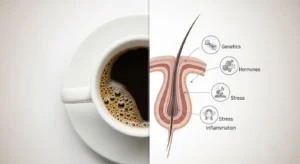
Lifestyle Factors That Truly Influence Hair Growth
Healthy hair growth usually improves when you focus on daily habits that support your body and scalp over time. The biggest changes often come from consistent basics, not quick fixes.
- Eat sufficient calories and protein to provide your body with the necessary tools for hair growth.
- Make sure you are getting enough iron in your diet, as iron deficiency has been known to cause hair shedding in some individuals.
- Try to manage your stress levels, as high stress can affect the hair growth cycle and make hair shedding worse.
- Avoid hairstyles that put too much tension on your hair, as this can cause thinning over time.
- Brush your hair gently to avoid breakage.
- Try not to use heat styling tools too much, as this can cause dryness and make your hair weaker and more brittle.
- Be aware of any health issues that may be causing hair thinning.
- If you experience sudden shedding, patchy balding, irritated scalps, or chronic thinning, consult a professional diagnosis instead of trying random solutions online.
- The best way to treat hair loss is to identify the cause, as different hair loss types need to be treated in different ways.
Support Healthier Hair Beyond Your Daily Coffee
Coffee may energize your day, but it does not address dryness, texture concerns,
or scalp irritation. Dr. Boogie’s Bionic Hair and Scalp Oil is a carefully crafted
botanical blend designed to nourish the scalp and improve manageability without
leaving a heavy or greasy feel. Just a few drops massaged into the scalp help soften
dry strands and ease discomfort. With Black Jamaican Castor Oil, Jojoba Oil, Tea Tree,
and botanical extracts, it supports balanced hydration, smoother texture, and
healthier-looking shine.
Conclusion
Having a cup of coffee can be a part of a healthy routine for many people, but it is not a scientifically supported standalone solution for hair growth. The current evidence for caffeine and hair problems appears more promising in lab research and topical applications, but true breakthroughs are often found by identifying the underlying cause of your thinning hair and maintaining a consistent hair care regimen.
If your goal is to grow stronger hair, improve moisture retention, and promote a healthier scalp, you should focus on routines that actually help your hair on a daily basis. Take a look at Dr. Boogie Secrets and purchase Bionic Hair and Scalp Oil to help smooth out your hair and make them healthy.