Hair growth can feel like a slow mystery. You do your best, you wash, you oil, mask and still your hair just seems to take forever to look fuller and healthier. Honey gets so much attention because it is natural, easy to obtain, and is often used in natural hair care to help retain moisture and promote a better scalp environment.
Honey can be helpful in supporting the scalp environment as it can help hair hold on to moisture and make the hair softer, especially when dry environment and breakage is making hair look thinner. However, it is not a magical way to regrow hair from the root. Read on to find out what honey can realistically do to make your hair grow, safety precautions to take while applying honey, and things that work better than a sticky honey mask!
Understanding Honey as a Natural Ingredient
Honey is a thick natural sweetener prepared by bees from the nectar of the flowers. It is largely sugars, along with minute amounts of acids, enzymes, and plant compounds which vary, depending on the type of honey. This mix is why honey behaves differently than a regular sugar syrup.
One of the things that makes honey special is that it is naturally unfriendly to quite a lot of microbes. It has a low water content and other properties that make it avoid spoilage and bacterial growth. This matters for hair care because a clean scalp environment is easier to keep balanced.
General Health Benefits of Honey
Honey is abundantly utilized in medical and wellness sectors, with the primary use associated with its soothing and antimicrobial properties. Medical grade honey is being studied in wound care because it may help promote a moist wound-healing environment and manage the load of bacteria in some scenarios.
For general use, honey is still a form of added sugar, so it should be treated as a “health food” you can consume in large amounts. But, as a topical ingredient, it can be useful, because it retains water that can be used to make skin feel softer and less tight.
Shelf Life and Stability of Honey
Honey is famous for lasting a very long time. It can darken or crystallize, but that does not automatically mean it is bad. However, honey can remain safe to eat indefinitely when stored and handled properly, and crystallization is a normal change.
For hair care, stability matters because you do not want a product that spoils easily. Still, keep honey clean, use a clean spoon, and close the jar well so you do not introduce water or bacteria.
A safety note that matters in any home with babies is that honey should not be given to infants under one year due to the risk of infant botulism. That warning is about eating honey, not using it on adult hair, but it is still important to know.
Is Honey Healthy for Your Hair?
Honey can be hair friendly, mainly because it acts like a humectant. A humectant pulls water toward it, which can help hair feel softer and less rough. This is why honey shows up in conditioners, masks, and scalp treatments.
The catch is that raw honey can be sticky and hard to rinse, especially if you use too much. Research on honey enriched skin products also highlights that stickiness is a real issue that formulators work to minimize. For hair, that means technique and dilution matter.
Effects of Honey on Hair Texture and Strength
Honey can help make hair feel more smooth, especially when your hair is dry or frizzy. When the hair holds on to moisture properly, it does not tangle and snap as much. That reduction in breakage is one of the biggest ways in which honey can make hair appear thicker over time.
Honey does not alter the speed at which the hair emerges from the follicle. What it can do is help you maintain the length by making the strands flexible. If your ends are always brittle, moisture support can be the difference between steady length and constant breakage.
Safe Application of Honey on Hair
Honey works best when you use it in a way that avoids residue and scalp irritation. Keep it simple and start with small amounts so you can see how your scalp reacts.
- Mix one tablespoon of honey with a few tablespoons of warm water, then apply to damp hair for 10 to 20 minutes
- Blend honey into a conditioner mask so it rinses out more easily
- Focus on mid lengths and ends if your scalp gets oily fast
- Shampoo well after, and rinse longer than you think you need
If you have a history of allergies, eczema, or a very sensitive scalp, patch test first. If you feel burning or strong itching, wash it out and stop using it.
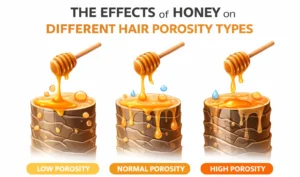
The Effects of Honey on Different Hair Porosity Types
Hair porosity is about how easily your hair absorbs and holds water. Honey can help some porosity types more than others, mainly because it pulls moisture and can leave a coating if overused. Use these quick guides to match honey to your hair type:
- Low porosity hair:
use very diluted honey and keep it short, otherwise it can sit on the surface and feel waxy - Medium porosity hair:
honey can help with softness, especially when mixed into conditioner - High porosity hair:
honey can support moisture retention, but you still need a sealing step like a light oil on ends
Natural Hair Lightening Effects of Honey
Some people use honey as a gentle way to brighten hair. The idea is based on chemistry, not magic. When honey is diluted, an enzyme called glucose oxidase can become active and help produce small amounts of hydrogen peroxide.
The effect is usually subtle and slow. It may show more on lighter hair shades, and it can still dry hair out if you do it often. If you try it, apply a conditioner after washing hair and keep expectations realistic.
Honey’s Role in Supporting Hair Growth
Honey helps hair growth in an indirect manner. Hair growth looks better when the scalp is peaceful and with non-breakage of strands. Honey may help reduce the dryness, soothe irritation, and promote overall softness, which aids in length retention.
Honey has also been studied in scalp conditions that are associated with flaking. A clinical study examined the effect of topical crude honey for seborrheic dermatitis and dandruff based on symptoms such as scaling and itching. This doesn’t mean that honey cures dandruff for everyone, but it shows why honey is associated with scalp comfort.
If you are dealing with true shedding from the root, honey alone will not fix the cause. In those cases, the better move is to look at hormones, iron, thyroid health, stress, and scalp inflammation with a professional plan.
Why Honey Alone Is Not Enough for Hair Growth
Honey does not have the ability to override genetics, reset hormones. or re-build the nutrients your body lacks. If your hair follicles are shrinking because of pattern hair loss, you need evidence based treatment and not just home remedies.
Honey is also limited in its usefulness. It can attract dirt, leave residue, and make fine hair look oily if you overdo it. If you are not cleansing well afterwards, then instead of honey routine solving the issue, you may feel that your scalp is feeling heavier!
The Best Way to Get Honey Benefits for Hair Growth
Honey is best utilized as a small supportive step, not as the whole hair care routine. Here is the simplest way to use honey so it can benefit your hair without creating problems.
- Use honey once a week, and always dilute it or mix it into conditioner
- Keep scalp clean with gentle shampooing, especially if you have oil or flakes
- Condition mid lengths and ends every wash to reduce snapping
- Protect hair from heat as well as rough brushing as breakage is the biggest enemy of length.
Dr. Boogie Hair Oil for Stronger and Healthier Hair
Honey is known as a natural humectant, but using it on hair can be sticky and difficult to
manage. Dr. Boogie offers a far more convenient alternative with his Bionic Hair and Scalp
Oil—a professional formula refined in Hollywood to deliver deep scalp hydration and
healthy shine without messy buildup. Massaging a small amount into the roots helps support
circulation, while smoothing dry ends improves softness and manageability. With Tea Tree,
Jojoba Oil, and Black Jamaican Castor Oil, this botanical blend helps balance scalp oils and
supports thicker, more resilient, glossy-looking hair.
Conclusion
To sum up, honey can make hair feel softer and smoother, and easier to manage, which helps to lessen breakage and promote length retention. It can also provide scalp comfort for some people, especially when dryness and mild irritation are present. But honey does not directly make follicles produce more hair, and it cannot fix root causes like genetics, hormones, or nutrient gaps.
If you want the benefits of moisture and shine without the sticky mess, choose a routine you can actually keep up with. Add Dr Boogie Secrets’ Bionic Hair and Scalp Oil to your weekly and a daily routine for a clean lightweight solution to calm your scalp, seal moisture, and keep the strands strong and shiny.