If you straighten your hair frequently and it never seems to grow longer, it makes sense to wonder whether the flat iron is preventing your hair from growing. You see smooth hair, then you see split ends, then you see little pieces of broken hair around your shoulders and it starts to feel like your hair is stuck at the same length forever. Most of the time, what happens is not that your scalp stopped growing hair. It is that the hair that you already grew is getting weaker and breaking before you can enjoy the length.
For a recent, dermatologist reviewed medical source, the American Academy of Dermatology Association explains excessive heat can damage hair and recommends limiting hot tools and using low or medium heat with a heat protectant. In this guide, I will explain what straightening really does to hair, why it can create the illusion of slower growth, and how to keep your sleek style without sacrificing length, so keep reading.
Understanding Hair Growth and Why Heat Tools Get Blamed
The hair growth occurs beneath the skin. A strand starts within a follicle, grows upward, and you only see it when it emerges out of the scalp. That is why hair can be growing normally even when your overall length appears to be stuck. Healthy hair grows about 1/2 inch in a month and the majority of hairs grow for years before they fall out and are replaced.
Heat tools get blamed because they affect the part you can see and touch, which is the hair length. When the ends break off, the tape measure does not move. Your scalp may still be producing new growth the whole time, but you lose the older length little by little. So the real question becomes: are you losing growth at the root, or losing length from damage on the strand?
What Heat Actually Does to the Hair Shaft
A hair strand has layers. The outside layer is like tiny shingles that overlap, and its job is to protect what is inside. When you straighten, you use high heat and pressure to force the strand into a flatter shape. That can make hair look glossy at first, but repeated heat can rough up that outer layer over time.
However, too much heat can cause damage to hair and one should use low or medium settings with the help of a heat protectant. There is also one main rule that a lot of people miss that flat irons must be used on dry hair only. When the hair is moist, it is more fragile, and heat combined with moisture can lead to more breakage and roughness. If straightening is done too hot or too frequently or with too many passes, the strand loses its flexibility and stiff hair will snap faster.
Frequent Straightening and Its Impact on Hair Strength
Straightening twice a week sounds reasonable, and to a lot of people that may not be a problem, as long as you do it carefully. The problem is that damage from heat is often cumulative. One session may not make much of a difference, but more and more sessions add into one another, especially if you use high heat, press slowly, or over the same section again and again.
Here is a simple way to see how “twice a week” can either be fine or turn into constant stress.
| Straightening habit | What it does to hair over time | What you notice in real life | Better move |
| High heat to finish faster | Dries out the strand and weakens the outer layer | More frizz later, more snapping when brushing | Use low or medium heat and be patient |
| Many passes on the same section | Repeated wear in the same spot | Short broken bits, especially near the top layer | Do fewer passes, use smaller sections |
| Straightening hair that is not fully dry | Hair is weaker and more likely to break | Ends feel crunchy, sudden breakage | Only use a flat iron on dry hair |
| Pulling hair tight while ironing | Adds tension while heat is applied | Breakage near the hairline and crown | Hold hair gently, do not stretch hard |
| Never trimming split ends | Splits travel upward and cause more loss | Hair looks thinner at the bottom | Micro trims when ends look frayed |
Managing New Hair Growth After Regular Straightening
New growth is often healthier, but it is also more susceptible since it has not been weathered yet. These steps make the feeling of straightening more manageable:
- Start with clean and conditioned hair and wait for them to dry out completely before using a flat iron
- Use a heat protectant every time
- Work in small sections so you do fewer passes
- Keep the iron moving smoothly as opposed to clamping down slowly
- Protect the ends with extra conditioner or a light oil after styling
- If you can, alternate weeks where you straighten once instead of twice to give strands recovery time


Scenarios Where Straightening Leads to the Illusion of Slower Growth
A lot of people say, “My hair grows, but it never gets longer.” That sentence usually points to breakage and split ends. Straightening can make this illusion stronger because sleek hair shows every weak spot. When ends are thin, you notice it more on straight hair than on curls that hide wear.
Here are the most common situations where straightening makes growth look slower even when your scalp is doing its job.
- Your ends are splitting and snapping, so every inch you grow gets lost
• You straighten the top layer more than the bottom, so breakage looks like “thin spots”
• You keep re straightening pieces during the week, adding extra heat sessions
• You brush more when hair is straight, which adds friction and wear
• You straighten close to the scalp and irritate skin, which can increase shedding in some people
Growth Happens at the Scalp, Damage Happens on the Length
This is the simplest truth that changes how you think about straightening. Growth comes from the follicle. Most heat damage happens on the hair you can see, which is the length. That is why straightening usually does not “stop growth,” but it can absolutely stop length.
There are exceptions, and they matter. If someone burns their scalp repeatedly, or uses heat plus tight tension near the roots, or has a scalp condition that causes inflammation, then growth can be affected. If you notice widening part lines, bald patches, or sudden heavy shedding, it is worth seeing a board certified dermatologist for a real diagnosis.
Why Heat Styled Hair Needs Recovery Focused Scalp Care
Heat changes the strand, but recovery starts with the scalp because that is where new hair is formed. A calm, balanced scalp supports healthier new growth, and healthier new growth gives you a better chance at length because stronger strands tolerate styling better.
The American Academy of Dermatology Association recommends being gentle with wet hair and protecting your hair from heat, as heat causes damage across all hair types. When your routine involves scalp comfort, hydration, as well as less friction, you get shinier, healthier hair that is less prone to breakage.
The Celebrity Styling Routine That Protects Hair Despite Heat
Celebrities are not immune to damage, they just have systems that limit it. They prep hair so the iron does less work. They use heat protectant, they straighten only when hair is fully dry, and they keep the heat lower than people think. They also avoid endless touch ups during the week.
Instead of re-straightening daily, they preserve the style with a shower cap, a loose wrap, or a gentle night routine that reduces friction. And when ends start looking see through, they trim early, because split ends do not fix themselves, they climb upward.
Support Hair After Heat Styling
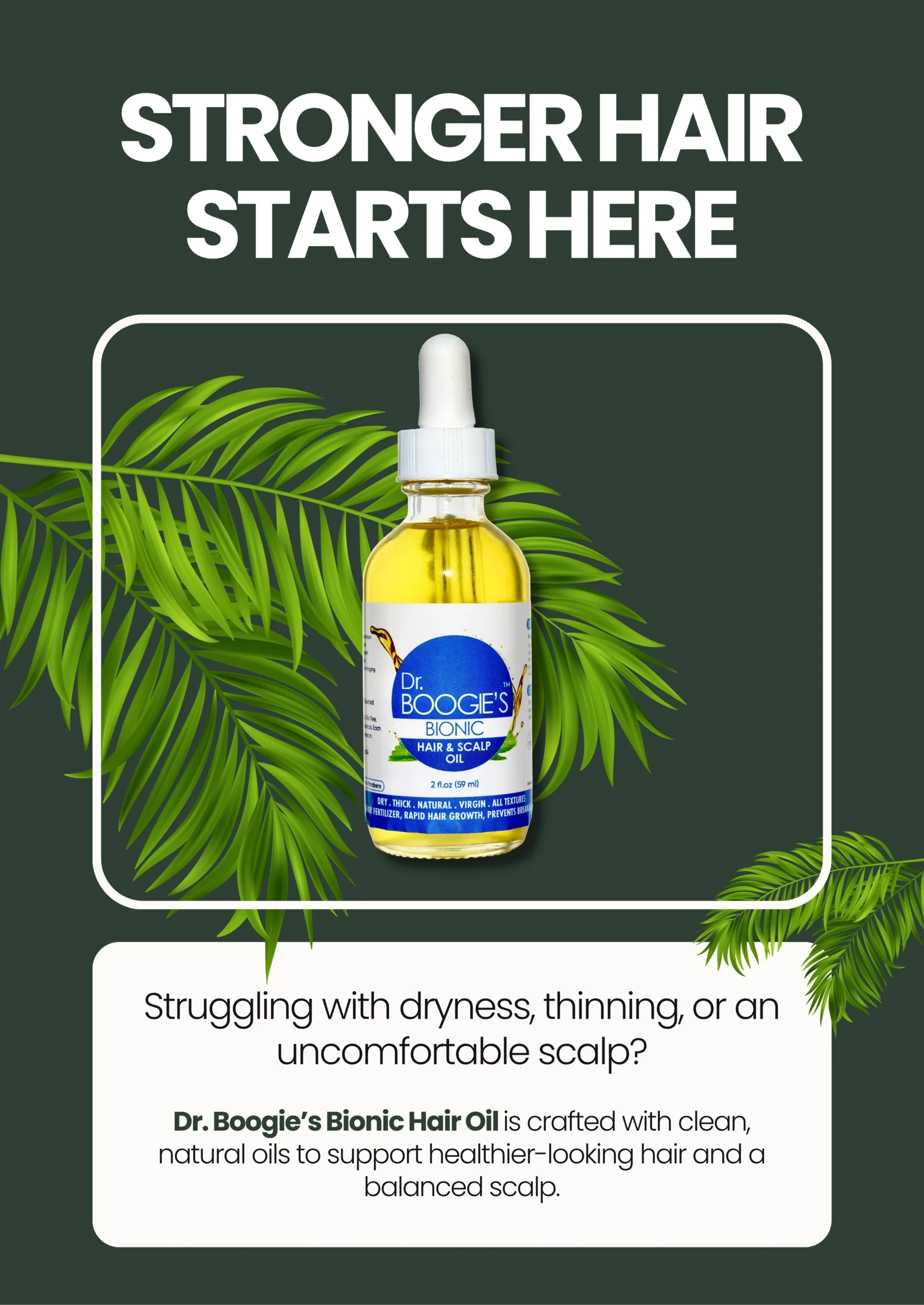
A few drops of Dr. Boogie’s Bionic Hair and Scalp Oil can help restore moisture, soften brittle strands, and improve shine after frequent heat styling. Its lightweight botanical blend also helps keep hair manageable and comfortable between styling sessions.
Conclusion
Straightening your hair does not often stop the hair from growing at the scalp. What it can do is weaken the hair shaft, especially if done repeatedly, too many passes, or high temperature, which makes hair prone to breakage and makes the growth look slow. The good news is you can retain the sleek look and still retain the length by reducing overall heat stress, using low or medium settings, applying a heat protectant, and straightening only dry hair.
If you need a simple upgrade, allowing for both comfort and resilience, build a daily scalp ritual with a special hair oil. Massage Dr. Boogie’s Bionic Hair and Scalp Oil into your roots to promote a calmer scalp and stronger hair strands. You can also add a few drops before styling to reduce friction and less heat passes so your straight hair stays glossy, soft, and full over time.